verb
verb (vʉrb)
noun
any of a class of words expressing action, existence, or occurrence, or used as an auxiliary or copula, and usually constituting the main element of a predicate (Ex.: give, build, run, be, happen, do, have, would, seem)
Etymology: ME verbe < OFr < L verbum, word (used as transl. of Gr rhēma, verb, orig., word)
verb
n.
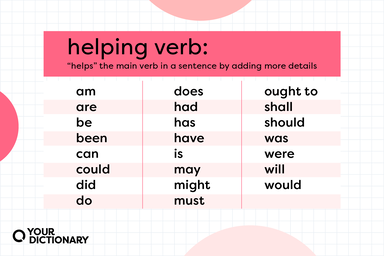
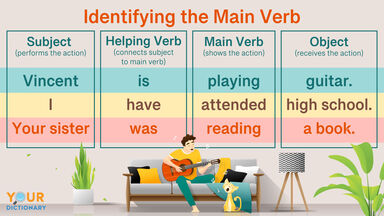
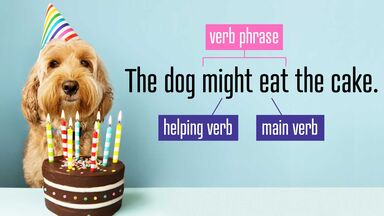
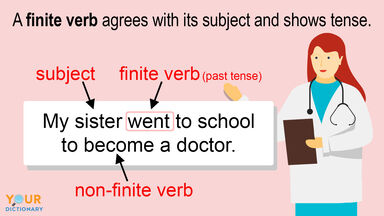
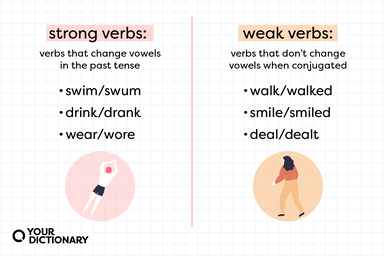
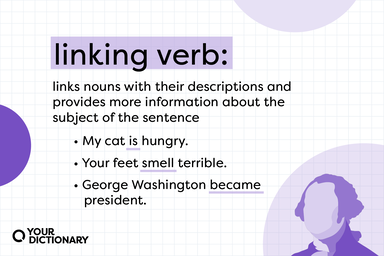
Types of verbs include: finite, active, neuter, passive, transitive, intransitive, auxiliary, linking, reciprocal, conditional, compound, action, helping, copulative, reflexive, strong, weak, regular, irregular, reduplicating, deponent, copula;
Converse of object
- conjugate: These girls are having a major difficulty conjugating verbs in different tenses.
- inflect: There is thus direct Old Persian evidence that the genitive was used to express the subject of the inflected passive verb.
- precede: Assume that the parser doesn't allow anything to precede the verb.
- translate: There is a very 190 CRISWELL THEOLOGICAL REVIEW brief but suggestive indication of how to render the verb usually translated " we know.
Preposition: in
- tense: These girls are having a major difficulty conjugating verbs in different tenses.
- sentence: O object the person or thing to which the action described by the verb in a sentence is ' done to ' ( e.g.
- clause: If the antecedent is the subject of the verb in the relative clause then qui is used.
Adjective modifier
- phrasal: They then start a chain letter to teach phrasal verbs to other students in the school.
- transitive: Never leave a transitive verb just lay there without an object.
- intransitive: In the sentence, The horse runs fast there is no object at all, so run is an intransitive verb.
- modal: For a more detailed look at the modal verb would, see our grammar archive.
- auxiliary: The auxiliary verb do is not used: DIRECT: " Do you like Oasis?
- irregular: There is an irregular verb Bandolier uses in its office.
Modifies a noun
- conjugation: It does include a box on present tense verb conjugation ( taking vowel harmony into account!
- tense: Time lines are also a great way of conveying the meaning of different verb tenses.
- inflection: The problem is more complex with verb inflections and in languages other than English.
- conjugator: A useful Italian verb conjugator hosted at the University of Trieste.
- morphology: From rote learning to system building: Acquiring verb morphology in children and connectionist nets.
- infinitive: The verb infinitive appears in large print at the right or left corner of the page along with the English translation.
Noun used with modifier
- infinitive: Modals are followed by the infinitive verb form, e.g. They must leave.
God, to me, it seems, is a verb not a noun proper or improper. See Hugo 421:83.
Le mot, c'est leVerbe, et leVerbe, c'est Dieu. The word is theVerb, and theVerb is God.