conscious
con·scious (kän′s̸həs)
adjective
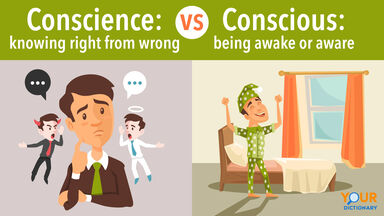
- having a feeling or knowledge (of one's own sensations, feelings, etc. or of external things); knowing or feeling (that something is or was happening or existing); aware; cognizant
- able to feel and think; in the normal waking state
- aware of oneself as a thinking being; knowing what one is doing and why
- self-conscious
- accompanied by an awareness of what one is thinking, feeling, and doing; intentional conscious humor
- known to or felt by oneself conscious guilt
Etymology: L conscius, knowing, aware < conscire: see conscience
the conscious
Psychol. that part of one's mental activity of which one is fully aware at any given time
conscious
modif.
Aware
cognizant, informed, sensible of, apprised, assured, inwardly sensible, discerning, percipient, apperceptive, felt, known, perceived, sensitive to, acquainted, attentive, watchful, mindful, vigilant, understanding, perceiving, noticing, knowing, preoccupied, keen, alert, awake to, alert to, alive to, on the qui vive, hip to*, hep to*, on to*, with it*, wise to*, on top of*; see also intelligent 1.Antonyms
unaware*, insensitive, inattentive. In possession of one's senses
awake, alert, sentient, endowed with consciousness, knowing, seeing, recognizing, able to recognize, in one's right mind, wide-awake; see also alive 1.Antonyms
unconscious*, insensible, in a faint. Deliberate
intentional, calculated, purposive, studied; see deliberate 1.
conscious implies awareness of a sensation, feeling, fact, condition, etc. and may suggest mere recognition or a focusing of attention conscious of a draft in the room, acutely conscious of her own limitations; aware implies having knowledge of something through alertness in observing or in interpreting what one sees, hears, feels, etc. to be aware of a fact; one is cognizant of something when one has certain or special knowledge of it through observation or information cognizant of the terms of the will; sensible implies awareness of something that is not expressed directly or explicitly sensible of their solemn grief
Preposition: of
- fact: Nelson recalled " I was very conscious of the fact that there wasn't much to go on.
- guilt: But there are others who are very conscious of guilt and sin.
- danger: On the other hand, in the matter of biblical interpretation I have been conscious of a different danger.
- importance: These changes, inter alia, have made the Bank especially conscious of the importance of its regional presence.
- need: UK banks are very conscious of the need for security for all types of electronic commerce.
- limitation: A theological praxis of liberation today needs to be conscious of these limitations.
Modifying Another Word
- acutely: The Labor leadership perhaps more than any other social democratic leadership is acutely conscious of the consequences of their economic strategy.
- environmentally: We try to be as environmentally conscious as possible.
- socially: Can I Be Socially Conscious With An Introductory Rate Credit Card?
- phenomenally: For example, a belief can give rise to a higher-order belief without thereby being phenomenally conscious.
- minimally: Out of a Coma, Into a Twilight Accident victim Robert Wendland is " minimally conscious.
- painfully: I was painfully conscious that the quality of what I was writing wasn't up to the standard I hoped for.
Modifies a noun
- sedation: We promote where possible the use of conscious sedation.
- mind: Most of what happens in the soul goes on below the level of the conscious mind [ 1 ] .
- effort: People who don't make conscious efforts to manage their weight get fatter over time.
- decision: Let's make a conscious decision to look for God at work in our lives.
- awareness: However the emotion is still passed from me to you outside both of our conscious awareness.
- thought: Conscious thought is only a small part of our whole brain activity.
Used with adjective complement
A man who has not been in Italy, is always conscious of an inferiority, from his not having seen what it is expected a man should see.
The wind's in the east I am always conscious of an uncomfortablesensationnowand thenwhenthewind is blowing in the east.
Nempe falluntur homines, quod se liberos esse putant; quae opinioinhoc soloconsistit, quodsuarum actionum sint conscii, et ignari causarum, a quibus determinantur. Haec ergo est eorum libertatis idea, quod suarum actionum nullam cognoscant causam. Men are mistaken in thinking themselves free; and this opinion consists of this alone, that theyare conscious of their actions and ignorant of the causes by which they are determined. This, therefore, is their idea of liberty, that they should know no cause of their actions.
Oh there is blessing in this gentle breeze, Avisitant that while it fans my cheek Doth seem half conscious of the joy it brings From the green fields, and from yon azure sky. Whate'er its mission, the soft breeze can come To none more grateful than to me; escaped From the vast city, where I long had pined A discontented sojourner: now free, Free as a bird to settle where I will.
Ever since I was engaged on Principia Mathematica, I have had a certainmethod of whichat first Iwasscarcely conscious, but which has gradually become more explicit in my thinking. The method consists in an attempt to build a bridge between the world of sense and the world of science.
Prendre conscience, disait ailleurs mon pe' re, c'est d'abord acque¤ rir un style. To become conscious, as my father said, one must first acquire a style.
The function of music isto release us from the tyranny of conscious thought.
Browse dictionary entries near conscious